Product Introduction
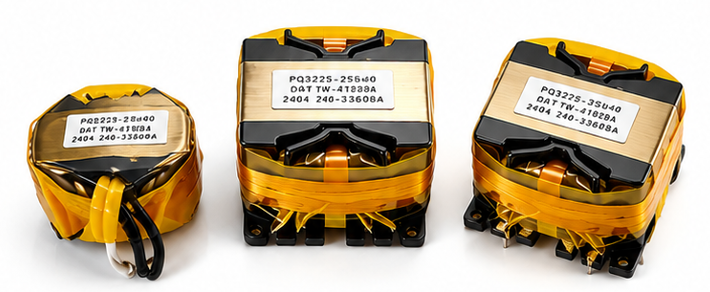
high frequency transformers are essential components in modern power electronics, providing efficient voltage conversion, electrical isolation, and stable power transmission in high-frequency switching applications.
Unlike traditional low-frequency transformers, high frequency transformers operate at much higher switching frequencies, allowing manufacturers to achieve smaller size, lighter weight, and higher power density designs. They are commonly manufactured with high-performance ferrite cores and optimized winding structures to reduce energy loss and improve conversion efficiency.
Designed for demanding electronic applications, these transformers provide reliable operation in switching power supplies, DC-DC converters, solar inverters, energy storage systems, EV charging equipment, industrial electronics, and communication devices.
The performance of a high frequency transformer depends on core material selection, winding design, insulation structure, thermal management, and electrical characteristics. Proper design helps improve system efficiency, reduce electromagnetic interference, and ensure long-term stability.
Key Specifications & Parameters
High Frequency Operation
Designed for high-speed switching applications, supporting efficient energy conversion in modern power supply systems.
Ferrite Core Structure
Utilizes high-performance ferrite materials with excellent magnetic properties, helping reduce core loss and improve operating efficiency.
Compact and Lightweight Design
Optimized construction enables smaller dimensions while maintaining reliable electrical performance for space-limited applications.
High Electrical Isolation
Provides effective insulation between primary and secondary circuits, improving safety and system reliability.
Customized Electrical Parameters
Transformer specifications can be adjusted according to voltage ratio, operating frequency, power rating, current requirements, and application conditions.
Stable Thermal Performance
Optimized winding methods and material selection help control temperature rise during continuous operation.
Main Functions
Efficient Voltage Conversion
High frequency transformers transfer electrical energy between circuits while converting voltage levels according to system requirements.
Electrical Isolation Protection
The transformer provides isolation between input and output circuits, helping improve equipment safety and reduce electrical risks.
High-Efficiency Power Transfer
Optimized magnetic design reduces energy loss and supports efficient operation in switching power systems.
Noise and Interference Reduction
Proper transformer design helps minimize electromagnetic interference and improve overall system compatibility.
Support for Compact Power Designs
Small size and high power density make high frequency transformers suitable for modern miniaturized electronic products.
Customized Power Solutions
Different transformer structures can be developed according to customer requirements, including power capacity, frequency range, and installation limitations.
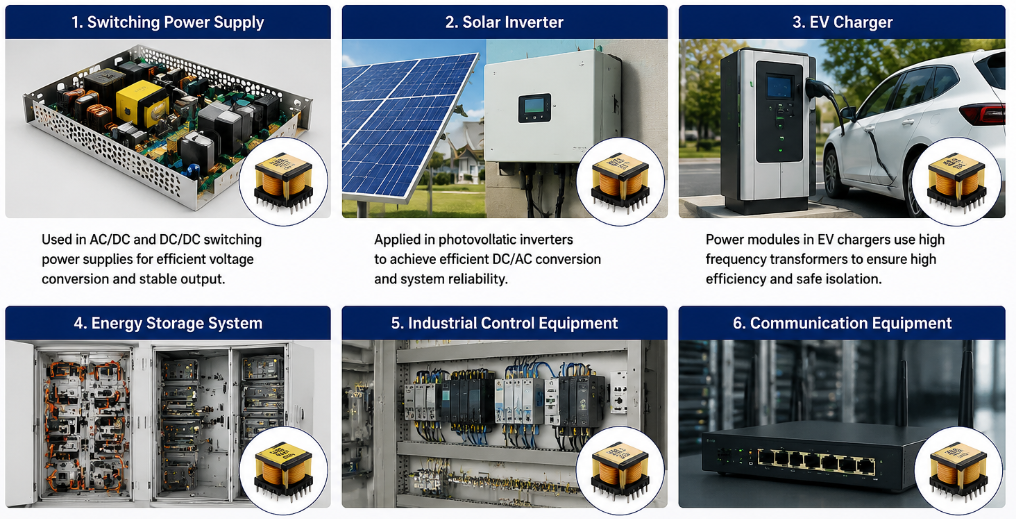
Specific Application Scenarios
Switching Power Supplies
High frequency transformers are widely used in AC-DC and DC-DC power supplies to achieve efficient voltage conversion and stable output performance.
Solar Inverter Systems
In photovoltaic applications, transformers help provide reliable isolation and power conversion between energy generation systems and electrical loads.
EV Charging Equipment
Electric vehicle charging systems require efficient power conversion. High frequency transformers support onboard chargers and charging power modules with stable operation.
Energy Storage Systems
Battery energy storage equipment uses high frequency transformers for power conversion, isolation, and improved energy management performance.
Industrial Control Equipment
Industrial automation systems, servo drives, and control equipment require stable power supplies where high frequency transformers provide reliable electrical performance.
Communication Equipment
Network devices, communication power supplies, and related infrastructure use Compact Transformers to maintain stable power delivery and efficient operation.
FAQ
Q1: What is a high frequency transformer used for?
A1: A high frequency transformer is mainly used for voltage conversion, electrical isolation, and efficient power transfer in switching power supplies, inverters, chargers, and electronic equipment.
Q2: What is the difference between a high frequency transformer and a traditional transformer?
A2: High frequency transformers operate at higher frequencies, allowing smaller size, lighter weight, and higher power density compared with traditional low-frequency transformers.
Q3: Why are ferrite cores used in high frequency transformers?
A3: Ferrite cores have excellent magnetic performance at high frequencies and help reduce energy loss, improve efficiency, and maintain stable operation.
Q4: Can high frequency transformers be customized?
A4: Yes. Transformers can be customized according to voltage requirements, frequency range, power capacity, size limitations, insulation requirements, and application environment.
Q5: What industries use high frequency transformers?
A5: They are commonly used in renewable energy, EV charging, energy storage, industrial automation, communication equipment, consumer electronics, and power supply systems.
Q6: How can high frequency transformer efficiency be improved?
A6: Efficiency can be improved through proper core selection, optimized winding design, reduced power loss, effective thermal management, and accurate electrical parameter matching.
Q7: What should be considered when selecting a high frequency transformer supplier?
A7: Customers should consider engineering capability, customization ability, production consistency, quality control process, and experience with similar applications.






 Phone
Phone